
Is Your Dog Competition Ready?


There comes a point in almost every dog sport when training begins to raise an exciting question:
Are we ready to compete?
Perhaps your dog can complete all the exercises required in your class. Your heelwork is coming together, the stays are reliable and the recall looks excellent at training. Or perhaps your Agility dog is confidently completing courses and you're beginning to think about that first competition.
It can be very tempting to decide that you're ready.
But knowing the exercises and being ready to compete aren't necessarily the same thing.
Competition introduces a whole collection of things that don't exist in quite the same way during training: unfamiliar surroundings, strange dogs, spectators, waiting around, travelling, different equipment and, of course, a handler who might suddenly be behaving rather differently!
So before completing that entry form, it is worth asking a slightly broader question.
Is your dog ready for the whole competition experience?
1. Can Your Dog Perform Away From Home?
Dogs don't automatically understand that something they have learnt in one place applies everywhere.
Your dog might perform beautiful heelwork at your regular training club but find it considerably more difficult on unfamiliar grass surrounded by dozens of dogs.
That's perfectly normal.
Before entering a competition, give your dog plenty of opportunities to practise familiar exercises in different places.
Train in another field. Visit a different training club where appropriate. Practise in a friend's garden. Work with different people nearby.
You don't need to deliberately make things extremely difficult. The objective is simply to help your dog learn:
"We can work together wherever we happen to be."
If your dog's performance initially deteriorates somewhere new, don't worry. Make the exercise easier, reward generously and gradually rebuild the behaviour.
Competition shouldn't be the first time your dog is asked to work somewhere unfamiliar.
2. Can Your Dog Cope With Other Dogs?
Dog competitions can be busy places.
Dogs may be walking past, barking from vehicles, warming up nearby or waiting with their handlers.
For some dogs, that is exciting. For others, it can be worrying.
Your dog doesn't need to want to meet every other dog at a competition – and generally shouldn't be expected to.
What matters is whether they can remain comfortable and manageable in an environment where other dogs are present.
Can your dog walk past another dog without becoming excessively excited?
Can they concentrate on you when another dog is working nearby?
Can they settle at a sensible distance from the activity?
These skills are every bit as important as the exercises you practise for the competition itself.
If your dog finds busy environments difficult, more gradual preparation may be needed before competition becomes enjoyable.
3. Can Your Dog Wait?
This is one of the least glamorous parts of dog sport – but potentially one of the most important.
Competitions involve waiting.
Sometimes quite a lot of it.
You might arrive early, wait for your class, exercise your dog, wait again and then discover there is another delay before it is finally your turn.
A dog that is perfectly happy working for five minutes may find spending several hours at a competition much more challenging.
Teach your dog how to relax between periods of activity.
Depending on the event and individual dog, that might mean resting safely in the car when conditions allow, settling in a crate or relaxing with you away from the busiest areas.
Being able to switch off is an extremely useful skill for a competition dog.
A dog that spends hours watching every movement, reacting to every passing dog and anticipating its turn may be mentally exhausted before entering the ring.
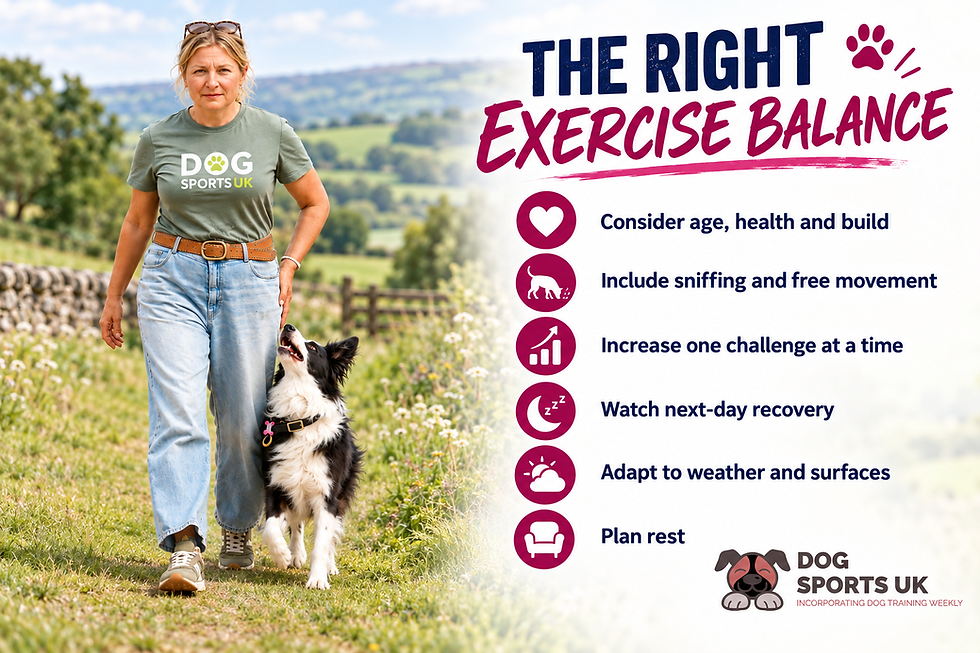
4. Is Your Dog Physically Prepared?
Competition readiness isn't only about training.
Your dog also needs to be physically capable of comfortably performing the activity.
Different sports place very different demands on the canine body. Agility involves acceleration, jumping and rapid changes of direction. Working Trials can require considerable stamina and athletic ability. Heelwork to Music may involve repeated movements and changes of position.
Even Obedience exercises such as recalls and retrieves involve bursts of physical activity.
General fitness should therefore develop alongside technical training.
Body condition, muscle strength, stamina and appropriate preparation all matter.
Before competing, ask yourself whether your dog is physically ready for what you are going to ask them to do – not simply whether they know how to do it.
And don't forget the warm-up.
A few minutes of progressive movement before training or competition can help prepare both body and mind for activity.
5. How Does Your Dog Handle the Unexpected?
Training sessions tend to be relatively predictable.
Competitions aren't always.
Someone may drop something outside the ring. A dog may bark. Applause might suddenly break out. A tannoy announcement could start. A steward might stand somewhere your dog isn't expecting.
Outdoor events add another collection of possibilities: wind, rain, flapping tents, uneven ground and interesting smells.
We can't prepare dogs for every possible distraction.
Nor should we try.
Instead, good training builds a dog that can notice something unexpected and then reconnect with its handler.
Confidence matters more than perfection.
If something surprises your dog, can they recover?
That ability to recover and continue is a valuable competition skill.
6. What Happens When Rewards Aren't Immediately Available?
Training and competition are different.
During training, we can reinforce our dogs frequently.
In competition, the rules of the particular sport determine when and where rewards can be given.
That transition needs to be trained.
If your dog is accustomed to receiving food after every few seconds of work, suddenly expecting several minutes of performance without the same reinforcement pattern can be a considerable change.
Gradually build longer sequences during training while maintaining enthusiasm and motivation.
But don't turn every training session into a competition simulation.
Rewards remain an important part of training.
The objective is to help the dog understand that sometimes several behaviours happen before the reward arrives – and that working with you remains worthwhile.
7. Is Your Dog Comfortable Being Examined or Approached?
Depending on your sport and class, judges, stewards or other officials may need to come relatively close to your dog.
Make sure your dog is comfortable with the interactions likely to occur in your chosen activity.
Again, this isn't something to discover for the first time at a competition.
Read the current rules and understand exactly what will be expected.
Competition preparation should include the whole exercise, including the presence and actions of officials, rather than only the part performed by the dog.
8. Can You Recognise When Your Dog Has Had Enough?
Perhaps the most important competition skill belongs to the handler.
We need to be able to recognise when our dogs aren't coping.
Watch for changes in behaviour.
Is your normally enthusiastic dog becoming reluctant?
Are they struggling to concentrate?
Are they unusually restless?
Do they appear tired, uncomfortable or worried?
Sometimes withdrawing from an event, missing a class or deciding not to compete is the right decision.
An entry fee has already been paid. You may have driven a considerable distance. You may have been looking forward to the event for weeks.
None of those things changes what your dog needs on the day.
There will always be another competition.
And Finally… Are YOU Competition Ready?
This is the question we sometimes forget to ask.
Handlers behave differently at competitions too.
We become nervous.
We talk differently. We hold ourselves differently. We may tighten our shoulders, change our breathing and suddenly become very serious about exercises that are normally enjoyable.
And our dogs notice.
You don't need to eliminate nerves. Even very experienced competitors can feel nervous before entering the ring.
Instead, develop a routine.
Know where you need to be. Allow plenty of time. Prepare your equipment in advance. Warm your dog up sensibly. Take a moment before entering the ring and remember why you started training together in the first place.
Your first competition doesn't need to produce a qualification, a clear round, a place or a rosette to be successful.
Perhaps your dog worked happily in an unfamiliar environment.
Perhaps they settled beautifully while waiting.
Perhaps you managed your nerves better than expected.
Perhaps something went wrong – but your dog recovered and carried on.
Those are achievements too.
A Simple Competition Readiness Check
Before making that first entry, ask yourself:
✓ Can my dog perform familiar exercises in several different locations?
✓ Can my dog work with other dogs and people nearby?
✓ Can my dog relax and wait between periods of activity?
✓ Is my dog physically prepared for the demands of the sport?
✓ Can my dog recover from unexpected distractions?
✓ Have I gradually prepared my dog to work without constant reinforcement?
✓ Is my dog comfortable with the people and procedures they will encounter?
✓ Can I recognise when my dog is becoming tired, worried or uncomfortable?
✓ Do I understand the rules of the class I am entering?
✓ Am I prepared to put my dog's experience ahead of the result?
If several answers are "not yet", that doesn't mean your dog will never be ready.
It simply gives you something useful to work on.
Your First Competition Is Part of the Training
Perhaps the best way to approach a first competition is not to think of it as the final examination of everything you've taught your dog.
Think of it as another stage in their education.
You will discover things about your dog that you couldn't learn at your normal training ground.
Maybe they find the atmosphere exciting. Perhaps they need more practice settling. Perhaps their concentration is better than you expected.
Take that information home and use it.
Competition and training should work together.
Train. Compete. Learn. Adjust. Train again.
And remember that a successful competition dog isn't simply one that can perform every exercise perfectly.
It is a dog that is physically prepared, confident in the environment, able to work happily with its handler – and, above all, still enjoys the game the two of you are playing together.
Because long after the scores, places and rosettes have been forgotten, that partnership is what really matters.


Comments