
Senior Dogs and a Rewarding Retirement


As the season draws to a close, some partnerships will be preparing for their final competition. Senior Pet Month is an opportunity to consider what comes next — and how to give older dogs a retirement filled with interest, companionship and activities they enjoy.
The show bag is being unpacked, the winter diary looks quieter and thoughts are turning towards another season. For some handlers, however, the question is whether their dog will be back in the ring at all. Others may be hoping to finish their competitive partnership at Crufts in March 2027.
Retirement can feel like a major change after years of training together. There are routines, friendships and ambitions wrapped up in a sporting partnership. Yet the things a dog enjoys about that partnership can continue: spending time with their person, solving a problem, earning a reward and sharing an outing.
A rewarding retirement begins by looking at the dog in front of us. What still makes them enthusiastic? What has become difficult? What could we change so that they can continue enjoying their days?
Choosing the right time
There is no single age at which every dog should retire. Size, health, previous injuries and the demands of the activity all matter. A dog comfortable with a short search may struggle with repeated jumping. Another may move freely but find a long journey and a crowded venue increasingly tiring.
Results tell only part of the story. Consider how your dog moves in everyday life, how readily they join in and how they recover after training. A dog who remains eager in the ring but is stiff later that evening needs attention just as much as one who starts refusing an exercise.
An intended farewell at Crufts can be a meaningful occasion for the handler, but it should remain a possibility rather than an obligation. If circumstances change, bringing retirement forward is a responsible decision. Your dog does not need a final appearance to complete a successful career.
Where it is practical and comfortable, introduce the retirement routine before competition ends. Try a gentler hobby, shorten familiar sessions and build in individual outings. This gives you both something enjoyable to move towards.
Start with a health review
Before changing activities, arrange a veterinary review and explain what your dog currently does. Discuss their mobility, previous injuries, weight and any changes you have noticed. Ask which movements and levels of exertion are appropriate, and how often their health should be reassessed.
Slowing down should not automatically be dismissed as age. Changes in behaviour or willingness to exercise can reflect pain or illness. Stiffness, limping, difficulty rising and reluctance to use stairs deserve veterinary attention.
Treatment and suitable management may improve comfort, but an enthusiastic response to treatment is not a reason to restore the old workload immediately. Agree a plan with your vet. Where appropriate, veterinary physiotherapy or hydrotherapy may form part of that plan; they should be chosen for the individual dog rather than added as a general retirement activity.
Preserve the partnership
A dog does not understand a retirement announcement. What they experience is the change in daily life: fewer sessions, different journeys or less individual time with their handler.
Keep the parts they enjoy. A familiar training cue can still lead to a short, rewarding game. Preparing the treat pouch can signal an easy search around the garden. A regular outing can become a leisurely sniffing walk instead of an intensive practice session.
This matters especially when a younger dog is taking over competition duties. Give the older dog their own time and activities, rather than expecting them to be satisfied by watching the newcomer work. They may enjoy coming to the club, but only if the visit itself suits them.
Some retirees remain sociable and relish familiar people. Others prefer quieter surroundings. Inclusion means choosing an experience the dog enjoys, even when that means leaving them comfortably at home.
Scentwork and a new purpose
Scentwork offers an appealing way to continue working together. The dog learns to locate a particular odour or item, while the handler learns to recognise and support the search. Scentwork UK describes it as an activity for dogs of different ages and breeds, with opportunities for both training and trials.
For a retired sporting dog, the attraction is flexibility. Searches can be short and set up within a small, accessible area. The challenge can come from finding the target rather than covering distance or negotiating obstacles.
An experienced instructor can help introduce the activity and adapt the set-up. Tell them about your dog's health and any movement restrictions. Ask for hides that do not require jumping, climbing, squeezing into awkward spaces or repeatedly stretching up and down.
At home, begin with an easy game: finding a favourite toy in plain reach or locating a few pieces of food in a small, safe area. Avoid slippery floors and inaccessible hiding places. Keep difficulty low enough for success and finish before the dog becomes tired or frustrated.
Formal odour training needs suitable materials and guidance. Do not improvise by applying essential oils to toys or leaving scented substances where the dog can lick or swallow them.
Scent trials may provide a new interest for handlers who enjoy organised events. However, consider the entire day: travel, waiting, surfaces, search areas and recovery afterwards. Ask organisers about the current rules and any available adjustments before entering. Recreational scentwork can be equally rewarding without the demands of competition.
Hoopers with thoughtful adjustments
Hoopers is another option worth exploring. Dogs negotiate courses using hoops, barrels and tunnels, and Canine Hoopers UK emphasises flowing courses with low-impact obstacles.
For some dogs retiring from agility, it offers a familiar sense of teamwork and directional handling without jumping. It may also appeal to dogs and handlers trying an activity together for the first time.
However, low impact does not mean suitable for every senior dog. Running, turning and passing through tunnels still demand physical effort. A dog with a joint, spinal, heart or other medical condition needs individual veterinary advice before taking part.
Choose an instructor willing to work within those recommendations. Foundation training might involve walking through a single hoop, responding to a direction cue or following a short, gently curved sequence. Consider footing, tunnel dimensions, speed and the number of repetitions.
There is no need to progress to full courses or timed competition. If your dog enjoys a few comfortable exercises and then rests, that is a worthwhile session. If even a simplified version is unsuitable, choose another activity.
Adapt the skills they already enjoy
Retirement need not mean starting from scratch. Familiar skills can provide enjoyable moments when their physical demands are reduced.
An obedience dog might enjoy a hand touch, locating a familiar article or a few relaxed steps beside the handler. Avoid asking for repeated position changes or sustained precision if those movements have become uncomfortable.
A Heelwork to Music partnership can retain the pleasure of responding to cues together. Choose comfortable movements, shorten the sequence and remove demanding turns, jumps or prolonged positions. The old routine does not need to be preserved.
For a Working Trials dog, an easy article search in a small area may retain a favourite element of training without the jumping or distances involved in previous work. Tracking, however, still requires consideration of terrain, length and physical effort.
Gentle trick training can also be useful, provided each trick suits the dog. Nose targeting or making a simple choice between objects may be more appropriate than balancing, spinning or repeatedly lifting a paw.
Assess the movement itself. An exercise described as “basic” can still be difficult for a particular dog.
Make everyday walks more rewarding
Many older dogs continue to enjoy being outdoors, even when their walks become shorter. Allow time to investigate scents, pause and choose a comfortable pace.
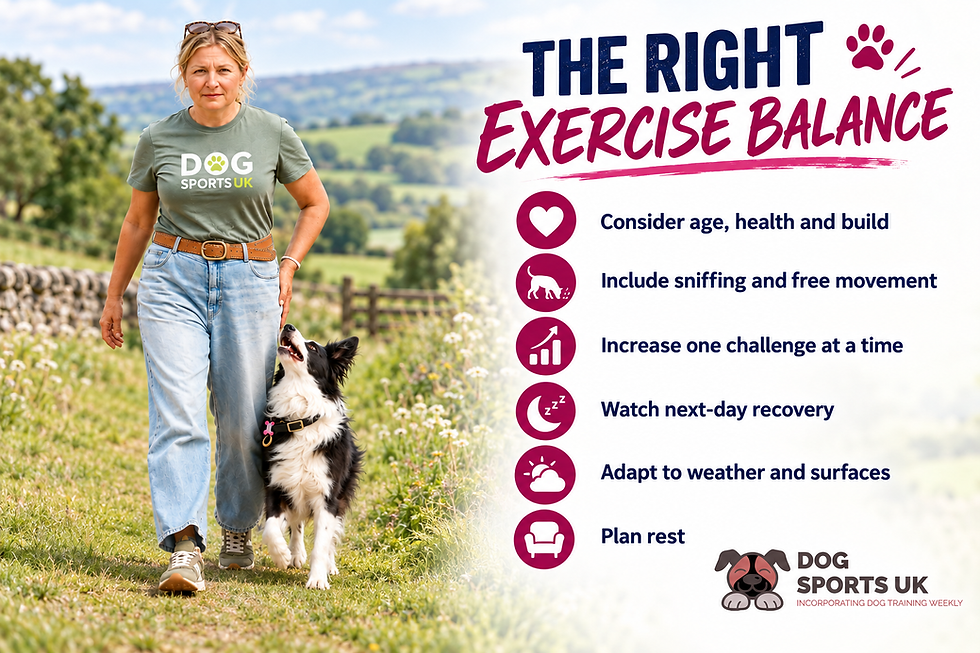
For dogs with mobility problems, regular, manageable outings are generally preferable to occasional demanding adventures. Your vet can help determine an appropriate pattern. There is no universal walking allowance based on age alone.
Choose routes with reliable footing and an easy way home. Autumn mud, wet leaves and icy paths can make a familiar walk more demanding. Consider the weather as well as the distance, and dry your dog after a wet outing.
Start gently rather than immediately asking for exercise. Afterwards, watch how your dog settles and how easily they move later. Their response across the day is more informative than their enthusiasm at the front door.
Repeated ball chasing can involve acceleration, abrupt stops and skidding. Where these movements are unsuitable, replace the chase with a calm search for the toy or another game agreed with your vet.
Build comfort into the home
Retirement is also shaped by the hours between activities. Look at your home from the dog's perspective: can they rise easily, reach their water and get outside without slipping or struggling?
Secure rugs or non-slip runners can help on smooth floors. Provide comfortable bedding in a quiet place, with enough room to stretch out. Where needed, discuss suitable access aids rather than relying on the dog to jump into the car or onto furniture.
Review feeding as activity changes. Reduced competition work may alter energy needs, but an older dog still needs appropriate nutrition. Ask your veterinary team about body condition, muscle loss and whether the current diet remains suitable. Include training treats in the daily food allowance.
Unexplained weight loss, increased thirst or a marked appetite change should be checked rather than managed simply by changing portions. Dental comfort also matters: reluctance to eat or hold an article may have a medical explanation.
In a household with several dogs, protect the retiree's resting space. A younger dog's invitation to play should never become persistent pestering.
Support changing senses and behaviour
Hearing or vision changes can affect how an older dog responds. A missed recall may no longer mean the same thing it did earlier in life. Use secure environments and appropriate lead management, and introduce useful visual cues while your dog can learn them comfortably.
Approach sleeping dogs gently and avoid startling them. Keep important routes and resources predictable, particularly if vision is deteriorating.
Some dogs develop cognitive dysfunction, which can involve confusion, disrupted sleep, house soiling or changes in familiar behaviour. These signs need veterinary assessment, because other conditions can cause similar difficulties. Do not punish mistakes or assume that the dog is being awkward.
Predictable routines, simple activities and patient support can help. Mental enrichment should remain enjoyable; a puzzle that leaves the dog struggling is not a useful challenge.
Review the whole day
A simple diary can help you notice patterns. Record the activity, willingness to participate, comfort afterwards and movement the following morning. Note appetite, sleep and any changes in behaviour.
Success is an activity the dog enjoys and recovers from comfortably. Finishing a course or finding every hide does not outweigh discomfort later. If you notice a problem, stop the demanding activity and seek advice before resuming it.
Review your plan as needs change. A dog who enjoys a club session this winter may prefer a short home search next spring. That adjustment does not make the earlier plan a failure.
Give the handler permission to adapt too. Retirement can bring sadness alongside relief, particularly after a long partnership. Celebrate the career with photographs, shared memories or a comfortable outing, without asking the dog for a performance they can no longer manage.
The next chapter can contain different pleasures: an easy find, an interesting walk, a familiar cue and time together. Our responsibility is to recognise those pleasures, make them accessible and keep listening as the dog tells us what they need.
A rewarding retirement gives an older dog comfortable opportunities to participate, alongside the freedom to rest. The partnership continues at their pace.
A retirement checklist
Arrange a veterinary review and discuss the demands of proposed activities.
Introduce enjoyable alternatives before competition ends where possible.
Preserve regular individual time, especially when a younger dog joins the team.
Choose comfortable footing, accessible searches and manageable sessions.
Consider travel and waiting as part of an activity's total demands.
Monitor recovery that evening and the following morning.
Reassess the plan whenever health, comfort or enthusiasm changes.
First Published in Dog Sports UK November 2026
This feature provides general information. Exercise, treatment and rehabilitation should be tailored to the individual dog with advice from their veterinary team.


Comments